AI Tools vs. Traditional Search: Transformation of Information Systems in Project and Program Management
Artificial Intelligence (AI) tools such as ChatGPT, Copilot, and Gemini are changing how people access information.
This paper analyzes the growth of AI tools compared with traditional search engines in the USA from 2023 to 2025.
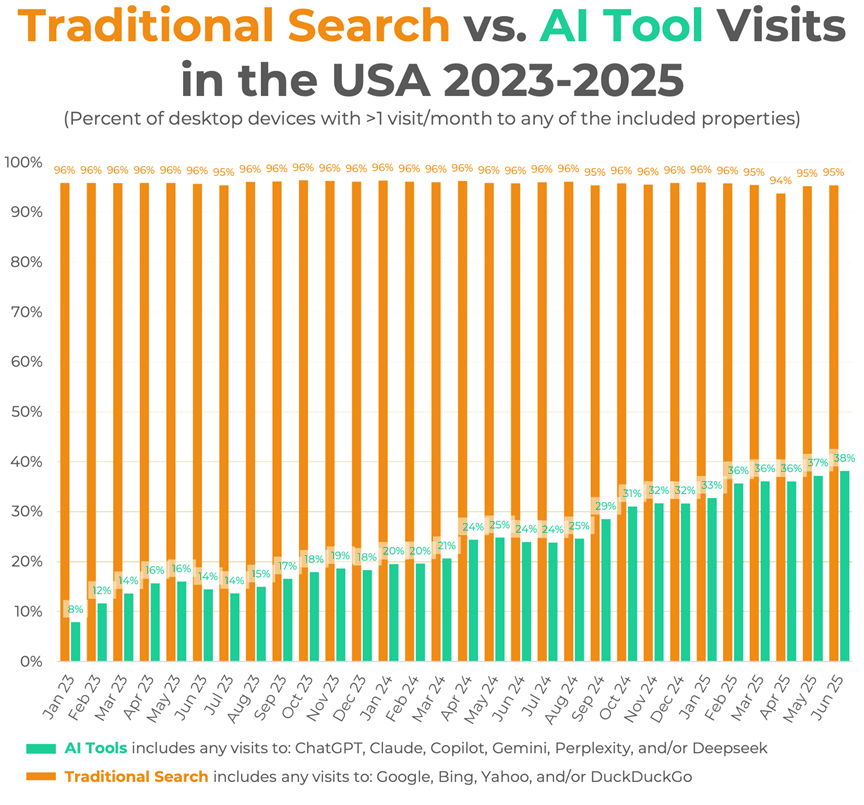
The findings show a rapid increase in AI adoption: from 8% of monthly users in 2023 to 38% in 2025.
Meanwhile, traditional search engines remain stable at 95–96% usage.
These shifts influence information systems and decision-making in marketing and project management.
The paper highlights how innovative technologies reshape strategies for the future.

Introduction

Artificial Intelligence (AI) has quickly moved from a futuristic idea to a practical reality. Today it is transforming not only marketing but also the way projects and programs are managed. One of the clearest indicators of this transformation is how people search for and process information. For years, traditional search engines like Google and Bing dominated. But since 2023, AI platforms such as ChatGPT, Claude, Copilot, Gemini, Perplexity, and DeepSeek have entered everyday use.

AI Growth vs. Traditional Search

In just two years, AI tools jumped from niche use to mass adoption: only 8% of Americans used them monthly in 2023, but by 2025 this number had exploded to 38%. At the same time, traditional search remained stable at around 95–96% of users. This contrast highlights a new balance between established systems and innovative tools (see Fig. 1).
Figure 1. AI Tools vs Traditional Search (2023–2025)
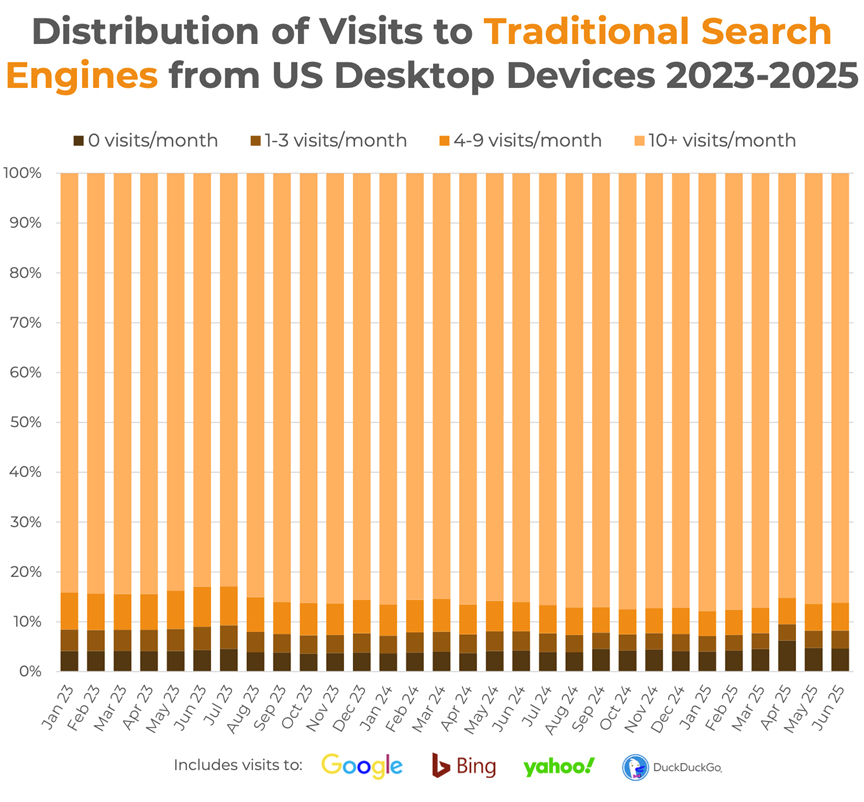
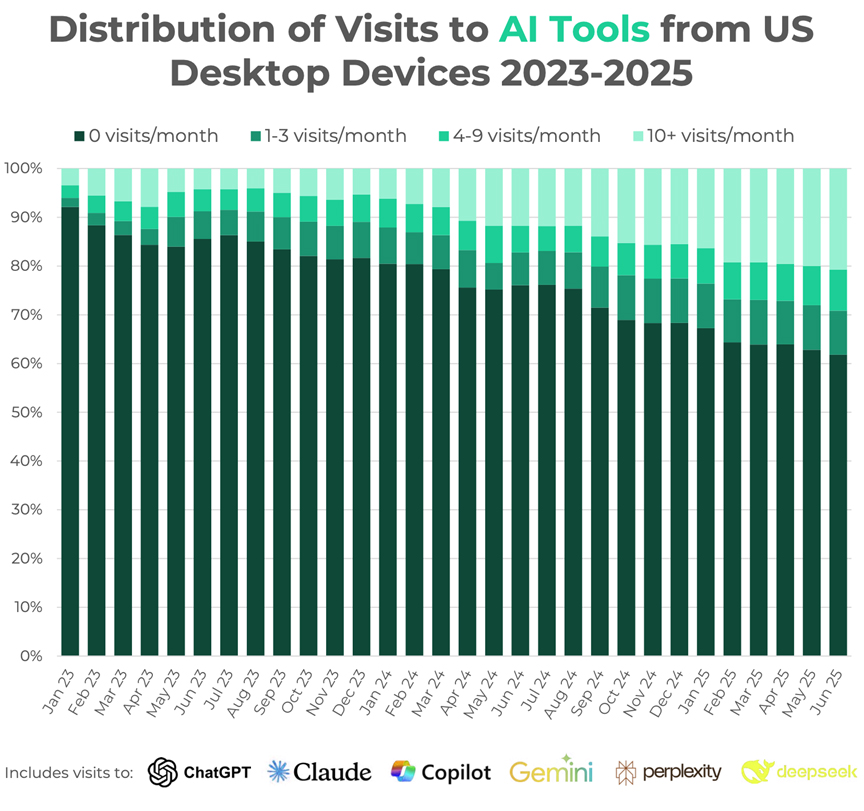
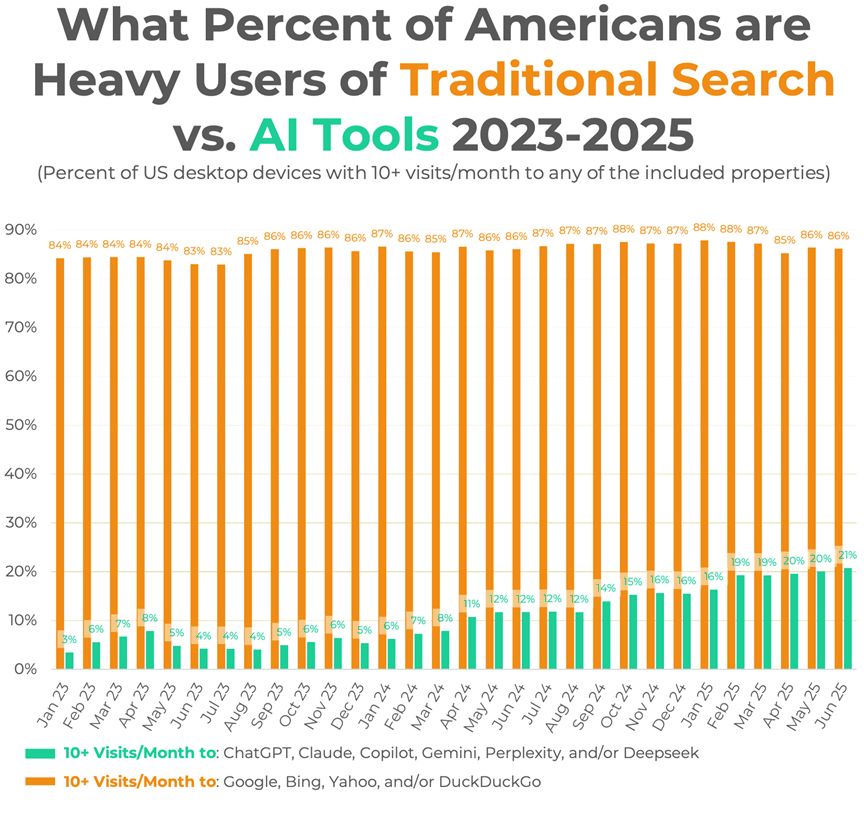
The number of heavy AI users (10+ visits per month) also grew dramatically—from just 3% in 2023 to 21% in 2025. In comparison, heavy users of traditional search engines stayed nearly unchanged, at about 85–88% (see Fig. 2).
Figure 2. Heavy Users: AI vs Search (2023–2025)

Search Volume Trends

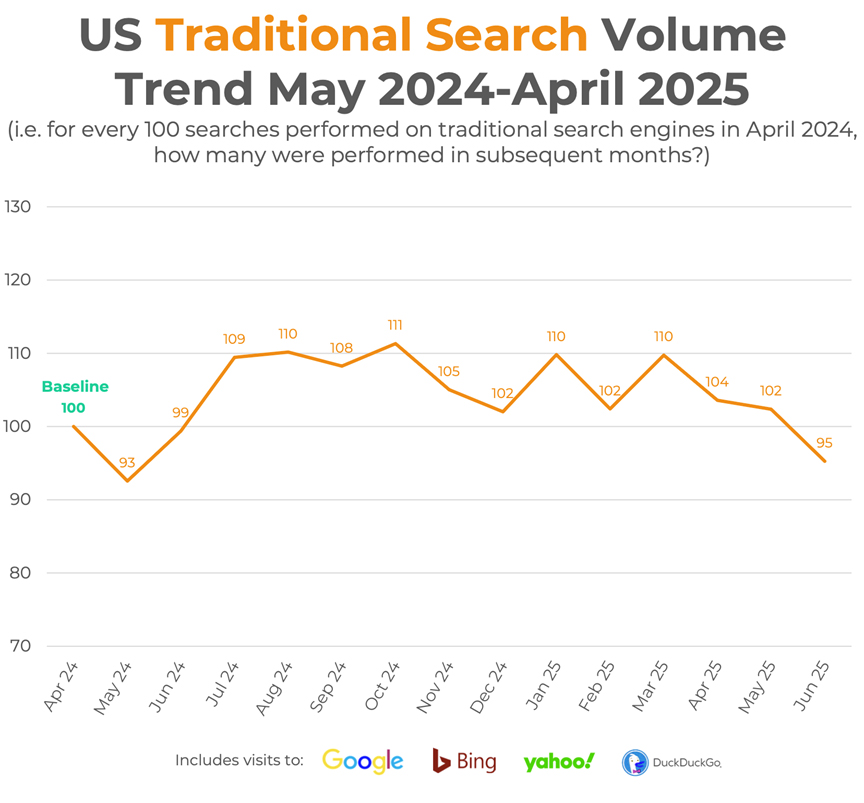
Traditional search volume has also started to fluctuate. Between May 2024 and April 2025, activity dropped as low as 93% of the baseline and rose as high as 111%. This volatility shows how user attention is being shared between search engines and AI platforms (see Fig. 3).
Figure 3. US Traditional Search Volume Trend (2024–2025)

Impact on Information Systems

These shifts reveal a hybrid model of information use. Traditional search is still the go-to for quick facts and navigation. AI platforms, however, are now preferred for deeper analysis, summaries, and creative tasks. For businesses and project teams, this means designing information systems that can integrate both worlds.

Applications in Marketing and Project Management

For marketing, the rise of AI means SEO strategies must expand beyond Google. Content should be created not just for human readers but also for AI systems that will summarize and recommend it. Ad strategies are evolving to include AI-driven recommendations and conversational interfaces. For project management, AI helps leaders process large volumes of data, generate insights, and communicate with stakeholders. This reduces time spent on routine tasks and increases focus on leadership and decision-making.

Ethical and Strategic Challenges

Still, AI adoption brings new challenges:
– Transparency: users may not understand how AI arrives at its answers.
– Bias: if training data is flawed, AI can reproduce these biases.
– Privacy: project and customer data must remain protected.
Project and program managers must therefore treat AI as a partner, not a replacement.

Future Outlook

Looking ahead, experts predict AI will handle up to 80% of project management tasks by 2030, such as monitoring and reporting (Harvard Business Review, 2023). At the same time, MIT Sloan research notes that 95% of companies investing in AI have yet to see financial returns, often due to poor integration. This shows the need for adaptive systems where AI and human expertise work hand in hand.

Conclusion

The rise of AI tools compared to traditional search engines is more than a change in user preference. It signals a deeper transformation in how information systems support marketing and project management. For organizations, the key lesson is that innovation is no longer optional. Success depends on embracing AI as an integral part of future strategies.

Appendix

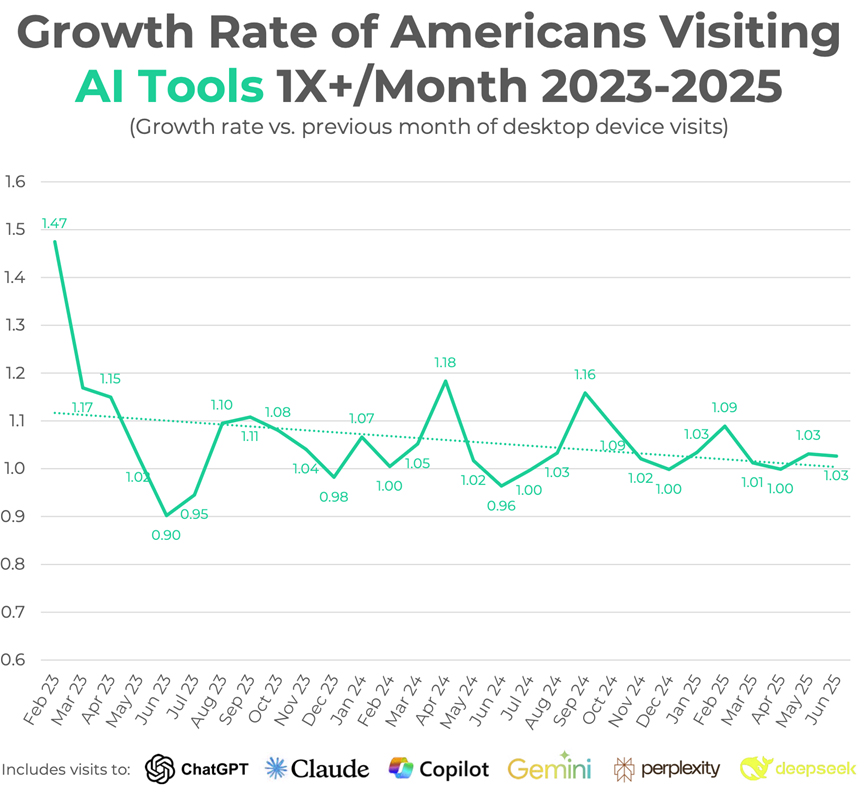
Figure A1. Growth Rate of AI Tool Visits (2023–2025)
Figure A2. Distribution of Visits to Traditional Search (2023–2025)
Figure A3. Distribution of Visits to AI Tools (2023–2025)

References

• Assembled & analyzed data. (2023–2025). Multi‑million device clickstream panel, USA: Growth of AI Tools vs. Traditional Search Engines. Internal dataset (conference report).
• Nieto‑Rodriguez, A., & Viana Vargas, R. (2023, February 2). How AI Will Transform Project Management. Harvard Business Review. Retrieved from https://hbr.org/2023/02/how-ai-will-transform-project-management
• McKinsey & Company. (2023). The State of AI in 2023: Generative AI’s Breakout Year. Retrieved from https://www.mckinsey.com/capabilities/mckinsey-digital/our-insights/the-economic-potential-of-generative-ai-the-next-productivity-frontier
• MIT Sloan Management Review. (2023). Why AI Companies Struggle Financially. Retrieved from https://sloanreview.mit.edu/article/why-some-ai-companies-struggle-financially
• WIRED. (2024, May 14). The End of Google Search Is Coming. Retrieved from https://www.wired.com/story/google-io-end-of-google-search/
• Grand View Research. (2024). Artificial Intelligence in Marketing Market Size, Share & Trends Analysis Report, 2024–2030. Retrieved from https://www.grandviewresearch.com/industry-analysis/artificial-intelligence-marketing-market-report
• Project Management Institute (PMI). (2023, October). Shaping the Future of Project Management With AI. Retrieved from https://www.pmi.org/learning/thought-leadership/shaping-the-future-of-project-management-with-ai