Behavioral Market Design™(BMD)
Designing how decisions happen in digital markets

The Core Idea
Markets are not messaging systems. They are decision environments
Traditional marketing tries to influence what people think. BMD designs the environment in which they decide.
The shift is from communication to architecture. That is the entire premise.
Why traditional marketing stalls
The Attract → Engage → Convert funnel assumes a linear journey through messages. Real journeys aren’t linear.
Decisions today are shaped by:
- algorithmic visibility
- cognitive overload
- fragmented touchpoints
- trust thresholds
- interface friction
None of these are persuasion problems. They are environment problems.
Optimizing campaigns inside a broken environment produces diminishing returns. The leverage has moved upstream, into the structure of the environment itself.
What BMD is
Why traditional marketing no longer works
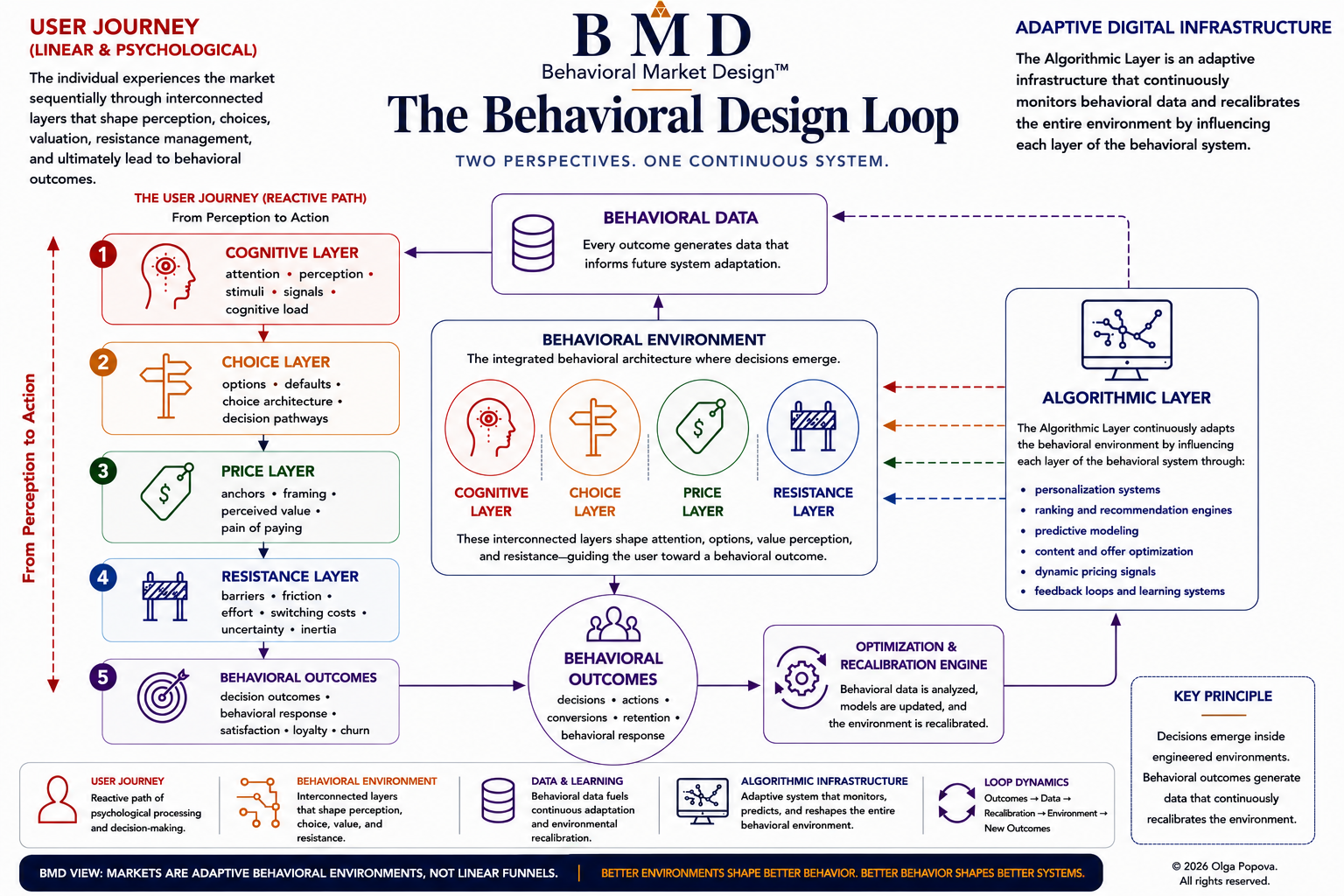
BMD is a framework for designing the conditions under which decisions occur. It integrates behavioral economics, cognitive science, pricing psychology, UX architecture, and adaptive algorithmic systems into one operational model.
It is not nudge theory applied to marketing.
Nudge theory works on individual choices. BMD works on the whole environment: how visibility is allocated, how alternatives are structured, how effort is calibrated, and how algorithms shape what users see in the first place.
It is not conversion rate optimization.
CRO optimizes pages. BMD redesigns the system pages belong to.
It is a framework of its moment.
Older models, including the behavioral economics that informs BMD, were built for environments where the medium was neutral. In current digital markets, the algorithm is never neutral: it selects, ranks, suppresses, recommends. BMD treats the algorithm as a co-architect of every decision, not as a delivery channel for a message.
The Five layers
From persuasion to decision architecture
A decision environment has five working layers. Each is a place where design changes outcomes.
1. Cognitive Layer
What gets noticed, what gets believed.
Attention, perception, trust signals, cognitive load.
2. Choice Layer
How alternatives are structured.
Defaults, comparison sets, the geometry of options.
3. Price Layer
How value is interpreted.
Anchoring, framing, reference points, willingness-to-pay signals.
4. Friction Layer
How effort is allocated.
What is made easy, what is made deliberate, where resistance is added on purpose.
5. Algorithmic Layer
What the system surfaces.
Personalization, ranking, recommendation logic, AI-mediated visibility.
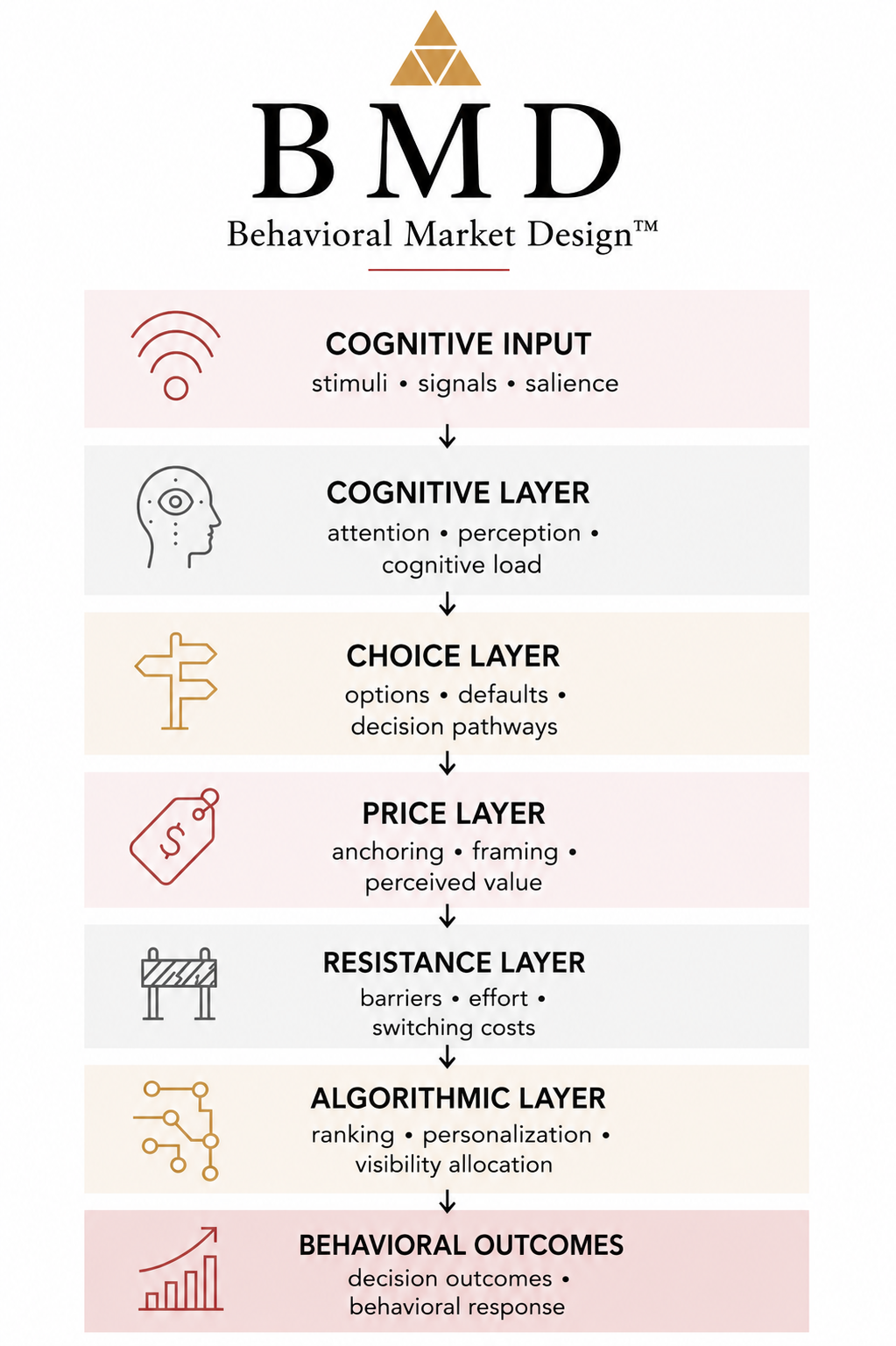
The layers interact.
A pricing change is also a cognitive change. A friction change reshapes the choice set. Reducing onboarding effort, for example, can lower a product’s perceived price by shrinking the total work required to reach value. That is the Friction Layer rewriting the Price Layer without changing the number itself.
BMD treats them as one environment, not five tactics.
How an Engagement Works
A system-level framework for designing decisions
A BMD engagement moves through four stages:
1. Map the environment.
Where do decisions actually happen for this market? What are the real touchpoints, not the assumed ones?
2. Diagnose the friction.
Where is cognitive load misallocated? Where do defaults work against the user, or against the business? Where does the algorithm hide what should be visible?
3. Redesign the architecture.
Restructure alternatives, recalibrate effort, realign price signals, reshape what the system surfaces.
4. Instrument and adapt.
Behavioral environments are not set-and-forget. They are tuned against ongoing signal.
Examples
Melisa-93
European market expansion
Context
Established Ukrainian B2B manufacturer of specialized agricultural equipment, with a strong product line and proven domestic position, expanding into multiple European markets simultaneously. Campaign performance varied dramatically by market despite identical product and identical creative.
BMD diagnosis
The problem wasn’t in the campaigns. It was in the decision environments.
- Cognitive Layer. Trust signals that carried weight regionally, like Eastern European exhibition awards, went unnoticed in Western EU catalog browsing, where certification frameworks shape buyer confidence.
- Choice Layer. The catalog assumed a commercial professional’s logic, but inbound was increasingly hobbyist and transitional buyers who needed a different entry path.
- Price Layer. Multi-currency display on the same page created silent friction at the moment of comparison.
Redesign
International recognitions (including first-place categories at the Plovdiv exhibition) elevated to primary visual hierarchy in markets where credentialing matters. Catalog re-architected around buyer intent (entry, scaling, professional) instead of product taxonomy. One display currency per market, with reference rates available on demand.
Result
Within one campaign cycle, inquiry quality stabilized across new markets. Exploratory questions gave way to configured requests, with buyers arriving aligned to specific product tiers rather than asking for orientation.
Mellifera
Visibility and inquiry architecture
Context
Romanian B2B manufacturer of specialized agricultural equipment, with strong product and competitive pricing, but weak inbound. Buyers were finding competitors first and arriving with comparison sets already built.
BMD diagnosis
This wasn’t a content problem. It was an Algorithmic Layer and Friction Layer problem.
The catalog was illegible to search systems: same SKU appearing under inconsistent naming, no structured comparison data, weak product schema. Where the catalog was discovered, the inquiry path was a single high-effort funnel in a market where buyers research outside business hours.
Redesign
Catalog restructured for machine readability before human readability, with consistent SKU logic, product schema, and structured comparison data exposed at catalog level. Inquiry path tiered: instant pricing and availability for routine purchases, dedicated escalation path for custom orders and trade buyers.
Result
Catalog coverage moved from search-invisible to consistently competitive on technical queries across Romania, Austria, and Germany. Inquiries shifted from after-hours dead ends to logged conversations that could be qualified and routed, opening a routing path that hadn’t existed before.
A premium DTC brand
Discoverability and category framing
Context
Direct-to-consumer brand with strong product affinity among the audience that found it. The brand wasn’t being found at scale. Search visibility sat in the long-tail zone, average positions on the third page, with click-through rates that outperformed benchmarks the moment impressions occurred.
BMD diagnosis
Conventional diagnosis was an SEO problem: keyword research, page optimization, link building.
BMD diagnosis was different. This was an Algorithmic Layer and Cognitive Layer problem layered on top of each other. The site was indexed under category vocabulary that matched industry convention but not how the brand’s actual buyers searched. On arrival, product organization mirrored internal taxonomy rather than the buyer’s mental model. Visitors had to translate their need into the brand’s language to navigate.
High CTR was masking the deeper issue: the few buyers who found the brand fit so well that nothing was wrong on the page. What was wrong was who was reaching the page at all.
Redesign
Category vocabulary rebuilt from actual buyer language (search queries, on-site behavior, review patterns) rather than industry defaults. Product taxonomy restructured around use cases and outcomes, with intent-matched landing pages replacing generic category pages. Trust signals like reviews, provenance, and product detail surfaced above the fold and structured for both human readers and machine parsing.
Result
Visibility moved out of long-tail-only positions into competitive ranking on intent-matched queries. The strong CTR carried over to a much larger impression base, and on-site behavior shifted from exploratory browsing to configured intent.
Where BMD applies
Any market where decisions are made inside a digital environment:
- B2B sales
- subscription services
- e-commerce
- education
- healthcare
- consulting
- platform design
- AI-mediated products
It applies especially where conversion has plateaued despite competent campaigns. That plateau is almost always an environment problem.
What changes
Engagements typically produce:
Digital markets are shaped by:
- cleaner conversion paths
- lower cognitive friction in onboarding
- more legible pricing
- better-qualified inbound
- decision environments that adapt instead of degrading over time
The deeper change is strategic.
Marketing stops being a stream of campaigns and becomes a designed environment that compounds.
Author
Olga Popova
FOUNDER & STRATEGIC MARKETING / GO-TO-MARKET LEAD
Olga Popova is a strategic marketing and go-to-market leader with more than 20 years of experience across U.S. and international markets.
She helps businesses enter new markets, launch new offers, and build practical systems for sustainable growth. Her work connects market insight, customer behavior, positioning, commercialization, and digital execution.
Throughout her career, Olga has led more than 200 strategic, digital, and commercialization projects across education, wellness, manufacturing, agritech, technology, media, and professional services.
She is the author of Psychology for Marketers and Behavioral Market Design, and the creator of Behavioral Market Design (BMD), an interdisciplinary framework focused on customer decision environments, trust, market behavior, and strategic commercialization.
Olga also develops professional education programs and training courses and contributes to international conferences, academic discussions, and interdisciplinary initiatives focused on behavioral systems, digital transformation, workforce adaptation, and AI-era market change.
Based in Greater Boston.