Your Ads Are Working. Why Isn’t Revenue Growing?
Your campaigns are generating impressions, clicks, inquiries, and leads. Cost per click is reasonable. Website traffic is up. The reports show activity.
Revenue, however, is not growing at the same pace.
The usual response is to optimize the campaign: change the targeting, test new creative, rewrite the landing page, increase the budget, or move spending to another platform. Sometimes that is exactly what the business needs. But sometimes advertising is already doing its job, and the real constraint sits elsewhere.
A company can generate more demand and still lose revenue through poor lead qualification, sales friction, inconsistent service delivery, customer churn, or an unsustainable business model. In that situation, a larger advertising budget does not solve the problem. It sends more people into a system that is already failing to preserve the value marketing creates.
If you scale advertising before you understand where revenue is being lost, you are not scaling growth. You are scaling friction.
Leads are not the same as business growth
Digital marketing makes activity easy to measure. Companies track impressions, clicks, conversions, inquiries, booked calls, and cost per lead. These metrics matter, but none of them proves that the business is growing sustainably.
A lead may:
- be interested but unable to pay;
- lack authority to make the final decision;
- want a service the company does not actually provide;
- respond only to a discount;
- require too much sales and service effort;
- leave soon after buying.
A campaign can therefore produce many leads while creating little economic value.
The problem becomes especially visible when marketing and sales define success differently. Marketing reports that it delivered the expected lead volume. Sales says the leads were poor. Leadership asks for more traffic without establishing where genuine opportunities are being lost.
Activity, pressure, and spending rise. Profitable revenue may not.
The first question should not be, “How do we get more leads?” It should be, “What happens to the demand we already create?”
The revenue problem may begin after the lead arrives
Customers do not experience marketing, sales, and operations as separate departments. They experience one company.
If an advertisement makes a clear promise but the sales conversation creates uncertainty, trust falls. If sales promises an outcome that delivery cannot support, dissatisfaction begins after the purchase. If onboarding is confusing or support is inconsistent, the customer may leave before the company recovers the cost of acquisition.
Marketing performance therefore cannot be judged only up to the point of conversion. Before the purchase, the business creates an expectation. After the purchase, the organization must prove that the expectation was justified.
When those two parts conflict, the company has more than an operational problem. It has a market problem that affects retention, reviews, referrals, reputation, customer lifetime value, and future acquisition costs.
Advertising can create the first transaction. It cannot, by itself, create a durable customer relationship.
More leads can put more pressure on a broken system
More demand does not automatically improve a business. It can expose and intensify weaknesses that were already there.
If inquiries are answered slowly, higher lead volume increases response times. If qualification criteria are unclear, salespeople spend more time on low-probability opportunities. If service quality is inconsistent, more customers may mean more dissatisfaction. If retention is weak, the company must keep replacing customers it already paid to acquire.
Salesforce reports that sales representatives spend most of their time on work other than direct selling. Sending more poorly qualified opportunities into that environment does not necessarily increase productivity; it may simply increase the work surrounding every successful sale.
Complex B2B purchases add another layer. Gartner describes the buying journey as nonlinear and shaped by multiple stakeholder concerns. Forrester’s 2026 research reports that a typical business purchase involves 13 internal stakeholders and nine external influencers, with larger networks for more complex decisions.
A person can like the product and still fail to secure approval from finance, IT, operations, procurement, or leadership. When that happens, the lost deal may have little to do with advertising quality. The real barrier is unresolved risk inside the buying group.
Lost deals are research the business has already paid for
Many companies record lost opportunities with labels such as:
- no response;
- too expensive;
- not interested;
- chose a competitor;
- bad lead.
These labels are convenient for reporting and weak for learning.
“Too expensive” may mean the buyer did not understand the economic value. “No response” may point to a difficult next step or high perceived risk. “Chose a competitor” may reflect greater trust, clearer implementation, or stronger support for the buyer’s internal case.
Lost deals are research the business has already paid for.
The company paid for media, sales time, meetings, proposals, and follow-up. If it never learns why the deal was lost, it pays for the lesson and then refuses to study it.
Behavioral Market Design treats lost opportunities as data. It looks for recurring patterns in expectations, perceived risk, trust, qualification, pricing, internal approval, delivery quality, and retention. The goal is not to decide whether marketing or sales is to blame. The goal is to identify the condition that repeatedly prevents demand from becoming durable value.
Why retention belongs in marketing diagnostics
Many organizations separate acquisition from retention: marketing brings customers in; operations or customer success keeps them. Economically, that separation is artificial.
When customers leave too early, the business loses future revenue and pays again to replace them. Weak retention therefore raises the effective cost of acquisition even when ad prices stay unchanged.
Bain’s loyalty research found that a 5% improvement in retention could increase profits by 25% to 95% in the businesses studied. This is not a universal formula: the effect depends on industry, margins, purchase frequency, and customer behavior. The underlying principle is still important. The duration and quality of a customer relationship can matter as much as the first sale.
A company that celebrates acquisition while ignoring preventable churn is counting people at the front door while leaving the back door open.
How Behavioral Market Design finds the real growth constraint
A conventional advertising audit asks whether campaigns generate traffic, leads, and conversions efficiently. Behavioral Market Design asks a wider question: Can the business turn the demand it creates into long-term customer value and economically sustainable growth?
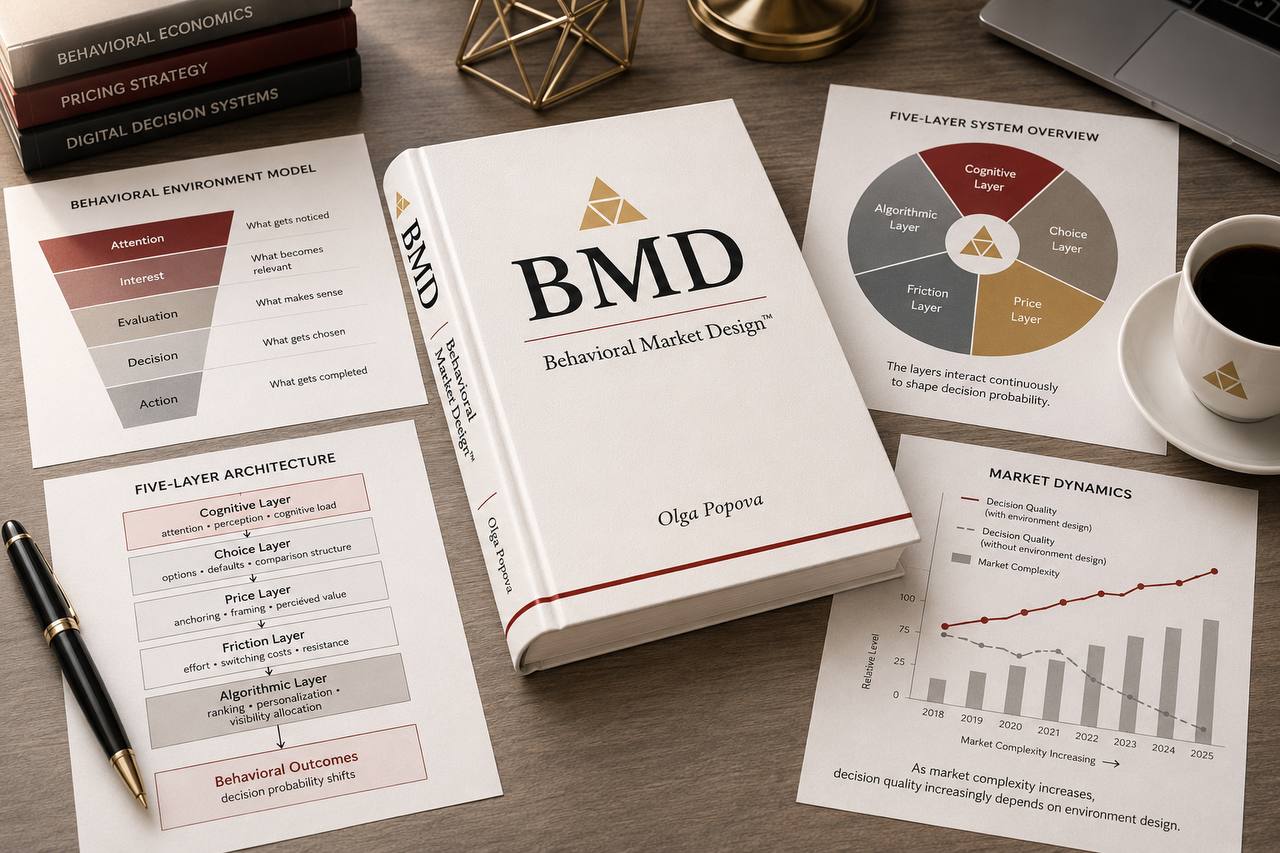
BMD examines five connected conditions.
1. Market–offer fit
Is the company attracting people whose needs, resources, expectations, and decision circumstances fit the offer?
A technically successful campaign can reach the wrong audience. More traffic from poor-fit prospects increases activity, not revenue quality.
2. Value clarity and trust
Can the customer understand the value, assess the risk, and move forward without unnecessary uncertainty or effort?
Customers are not neutral calculating machines. They interpret risk, protect themselves from uncertainty, rely on past experience, notice social signals, and assess how difficult the next step will be. A strong offer can still fail if people do not understand it, do not trust the provider, or cannot justify the decision.
3. Decision and conversion architecture
Does the company support the way the decision is actually made? Does it qualify opportunities consistently? Does it address the concerns of everyone who can influence the purchase?
In B2B, education, healthcare, professional services, and high-consideration consumer purchases, conversion is rarely just one person clicking a button. Marketing must do more than attract attention. It must provide the evidence people need to move a decision forward.
4. Delivery and retention
Does the experience after the sale match the promise that won the customer?
When acquisition works but delivery fails, the business loses both the customer and part of the value of its marketing investment. Retention is not merely a customer-service metric. It tests whether the company’s market promise is credible and repeatable.
5. Economic sustainability
Does the relationship create enough long-term value after acquisition, selling, onboarding, service, retention, and replacement costs are included?
Leads, sales, and even revenue can rise while profitability falls. Discounts, sales labor, onboarding, support, refunds, churn, and reacquisition all have a cost. BMD tests whether growth still makes economic sense after those costs are counted.
These conditions are interdependent. Improving one while ignoring the others may move a metric without improving the business.
An advertising audit measures campaign efficiency. Behavioral Market Design examines whether the business can preserve and increase the value advertising creates.
When successful acquisition reveals a broken business model
I saw this clearly in an education project.
The organization expected stronger digital marketing to produce more inquiries and enrollments. Acquisition did create new demand. Prospective students contacted the school and enrolled.
But lack of demand was not the only constraint. While marketing brought in new students, weaknesses in the educational experience and operating model contributed to dissatisfaction and attrition among students who had already enrolled.
The organization was trying to fill a container that was still leaking.
Each enrollment looked like an acquisition success. Each preventable departure reduced the economic value of that success. The organization then needed more advertising to replace students it had already paid to acquire.
If leadership looked only at inquiries and new enrollments, marketing appeared to be solving the problem. Once retention, student experience, operating capacity, and long-term enrollment value were included, the picture changed.
The main constraint was not simply insufficient demand. It was the organization’s inability to preserve the value of demand already created.
The project also revealed an important boundary. Marketing can identify risk, analyze expectations, improve communication, provide evidence, and recommend change. It cannot independently repair service delivery, management processes, or customer experience when those decisions sit outside the marketing function. In this case, the necessary changes were outside the scope of the marketing contract.
Increasing the advertising budget would not have produced sustainable growth. It would only have accelerated the replacement of departing students with new ones.
Behavioral Market Design is not another funnel
A traditional funnel maps movement from awareness and interest to consideration, conversion, and purchase. It is useful, but it can make conversion look like the finish line.
BMD treats conversion as a transition. Before the sale, the company makes a promise. After the sale, the organization must prove that the promise was realistic.
Behavioral Market Design therefore connects three dimensions that companies often manage separately:
- Psychology: how people perceive value, trust, uncertainty, risk, fairness, effort, and social influence.
- Economics: what it costs to acquire, convert, serve, retain, and replace a customer.
- Operations: whether the organization can consistently deliver what its marketing promises.
The goal is not to make every step more persuasive or push more people toward conversion at any cost. BMD creates the conditions in which the right customers are attracted, the value is clear, uncertainty is reduced, decisions are properly supported, promises can be kept, customers have a reason to stay, and revenue remains economically sound.
Having customers is not the same as having a working growth model. A growth model works when the business can attract suitable customers, deliver the promised value, retain an economically viable share of them, and learn systematically from the reasons it loses others.
What to check before increasing the advertising budget
If advertising generates activity but revenue is not growing, the first move should not be to buy more clicks.
First determine:
- whether the business attracts people who can become profitable customers;
- whether customers understand the value;
- where uncertainty or distrust appears;
- whether marketing and sales define a qualified opportunity in the same way;
- why real deals are lost;
- whether every participant in the decision receives the evidence they need;
- whether the post-sale experience fulfills the original promise;
- whether customers stay long enough to justify acquisition costs;
- whether the company measures the quality and economics of revenue, not only top-of-funnel activity.
The answers may show that the next dollar should go to advertising. They may also show that the company first needs to change the offer, qualification, sales support, onboarding, customer experience, pricing, retention, or internal process.
Good marketing does more than bring people to the door. It helps the right customers understand the value, make a sound decision, receive the promised outcome, and remain after the campaign ends.
That is the difference between buying activity and designing growth.
Where is your business losing revenue?
A Behavioral Market Design audit examines the entire system: market attention and acquisition, decision-making, delivery, retention, and long-term customer value.
Advertising can create demand. Behavioral Market Design determines whether the business is ready to turn that demand into sustainable growth.
Let’s find the barrier before you spend more money sending new customers toward it.
Olga Popova
Founder of Astar.Marketing
Creator of the Behavioral Market Design methodology
Author of Behavioral Market Design: From Persuasion to the Architecture of Choice